You’ll need it more often than you think.
Find yourself below. Each line is a moment you’ve had, and what OnceEver does with it, so the words you met there stay.
- Everyone
Whoever you are.
You’ve looked up the same word three times.
Keep it once. It comes back just before you’d forget it, until it stays.
Watch: Spaced reviewYou wrote an email or a message, and you’re not sure it’s right.
Check it: a native version beside yours, and every difference explained.
Watch: MarkingSomeone wrote to you, and you want more than the gist.
Translate and Learn: the whole text in your language, and each phrase you pick becomes a card.
Watch: PickingYou know what you want to say, just not how.
Write it in your language. OnceEver says it in theirs, and you learn it for next time.
Watch: From your language into theirsYou can read it, but you’ve never heard it said.
Listen says it as slowly as you need, with how each word is said written under it.
Watch: ListenA sign, a menu or a screenshot you can’t read.
Photograph it on iPhone or iPad, and keep the lines worth knowing.
Watch: Photograph it
- Students
You’re studying it.
The grammar point you didn’t ask about in class.
Ask in your own words, as often as you need, and keep the examples.
Watch: Questions you keepAn oral exam on a topic you can’t talk about yet.
Ask Ideas for a dialogue on it at your level, and pick the phrases you’ll use.
Watch: IdeasYour composition, and what a native would change in it.
Check marks it sentence by sentence, and what you got wrong comes back in review.
Watch: Marking
2 more moments ↓Fewer ↑
The set text you only half understand.
Photograph or paste the page, and pick the phrases worth keeping.
Watch: Picking
- At work
You work in it.
An email to a client you’re not sure about.
Check it before you send: the register, the words and the grammar, each difference explained.
Watch: MarkingA colleague said no so politely. How?
Learn from their email: pick the phrases, and they’re yours.
Watch: PickingNext week’s meeting, in a language that isn’t yours.
Ask Ideas for the call and the small talk after it, at your level, and rehearse the phrases.
Watch: Ideas
3 more moments ↓Fewer ↑
A message you have to answer now.
Write it in your language. OnceEver says it in theirs, and you learn it for next time.
Watch: From your language into theirsA reply you’re about to send in your team chat.
Share it before you send it, and get it checked when you open OnceEver.
Watch: Share from any app
- Travellers
You’re travelling.
You’ll have to ask the way, and understand the answer.
Rehearse it before you go with an Ideas dialogue, then hear each line said.
Watch: IdeasReviews only locals would write.
Ideas writes them at your level: pick the words that tell you where to eat.
Watch: Voicemails and reviews
3 more moments ↓Fewer ↑
You’ll have to say it out loud, with a queue behind you.
Hear it slowly first, then say it back in the pause Listen leaves you.
Watch: ListenA chat on the train you want to remember.
Type it in that evening. It’s still yours next year.
Watch: Spaced reviewYour host’s message with the directions.
Share it from the chat, and learn the words before you set off.
Watch: Share from any app
- Living abroad
You live there now.
A letter from the town hall, the bank or the landlord.
Photograph it or share the PDF, and learn the words every letter uses.
Watch: Photograph itYou’ll have to explain it at the doctor’s.
Rehearse it with an Ideas dialogue, and learn the words for where it hurts.
Watch: Ideas
3 more moments ↓Fewer ↑
The parents’ group chat at your child’s school.
Learn from it, and check your reply before you send it.
Watch: PickingA phone call you’d rather avoid.
Ideas writes a voicemail at your level, so the real one is easier.
Watch: Voicemails and reviewsThe neighbours’ small talk on the stairs.
Keep what they said. Next time, you answer.
Watch: Spaced review
- Fans
You love its series and songs.
A line you sing along to without knowing what it means.
Paste it in: it stays as it’s sung, with what it means and its words explained.
Watch: PickingA line from the series you’d love to say yourself.
Say where you heard it, and OnceEver writes a moment where you could say it.
Watch: The sceneA game or a manga in the language.
Photograph or share the screenshot, and pick the words.
Watch: Photograph it
3 more moments ↓Fewer ↑
Slang no textbook has.
Keep it as they say it, and ask what it really means.
Watch: Questions you keepThe comments under the video.
Share them from any app, and keep what’s worth it.
Watch: Share from any appA scene like your show’s, at your level.
Ask Ideas for flatmates arguing over the washing-up, and pick the lines.
Watch: Ideas
- Family & friends
You love someone who speaks it.
The toast at their wedding.
Write it in your language, and learn it in theirs by heart.
Watch: From your language into theirs
3 more moments ↓Fewer ↑
The phrases your grandmother used.
Keep them, and ask what they really meant.
Watch: Questions you keepA bedtime story in your child’s other language.
Hear it a part at a time, with how each word is said, before you read it to them.
Watch: Listen
A slow start, and a foundation that holds.
From your first words, every sentence holds something you don’t know yet. Expect the first weeks to be slow, and let them be: set your level to A1, so everything written for you stays within reach, and spend the time on what lies underneath.
Ask every basic question, as often as you need.
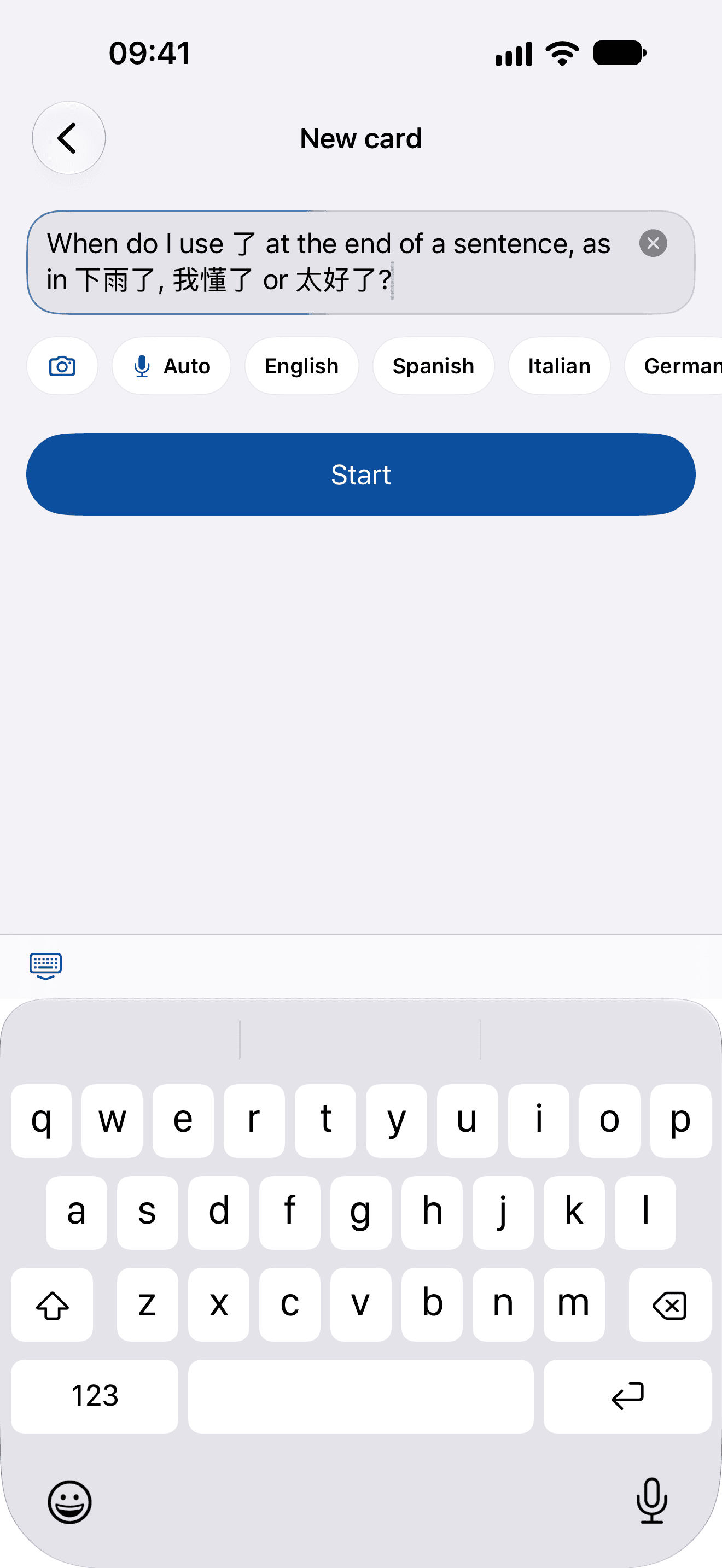
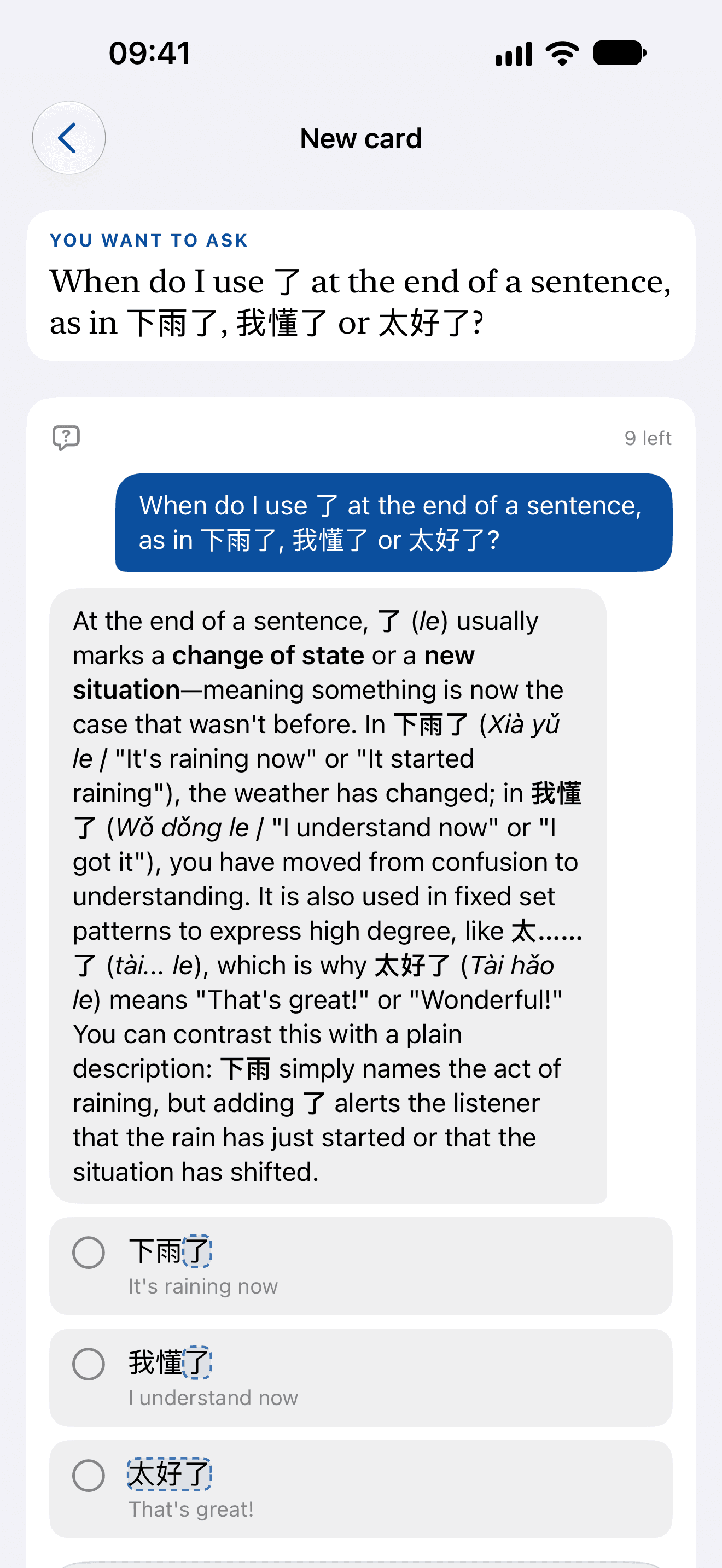
A beginner’s questions are the ground everything else stands on: when do I use 了 at the end of a sentence? Ask in your own words and your own language, as many times as it takes. The answer comes with examples you can keep, and each one comes back in review until it’s yours.
Keep new cards to a few a day.
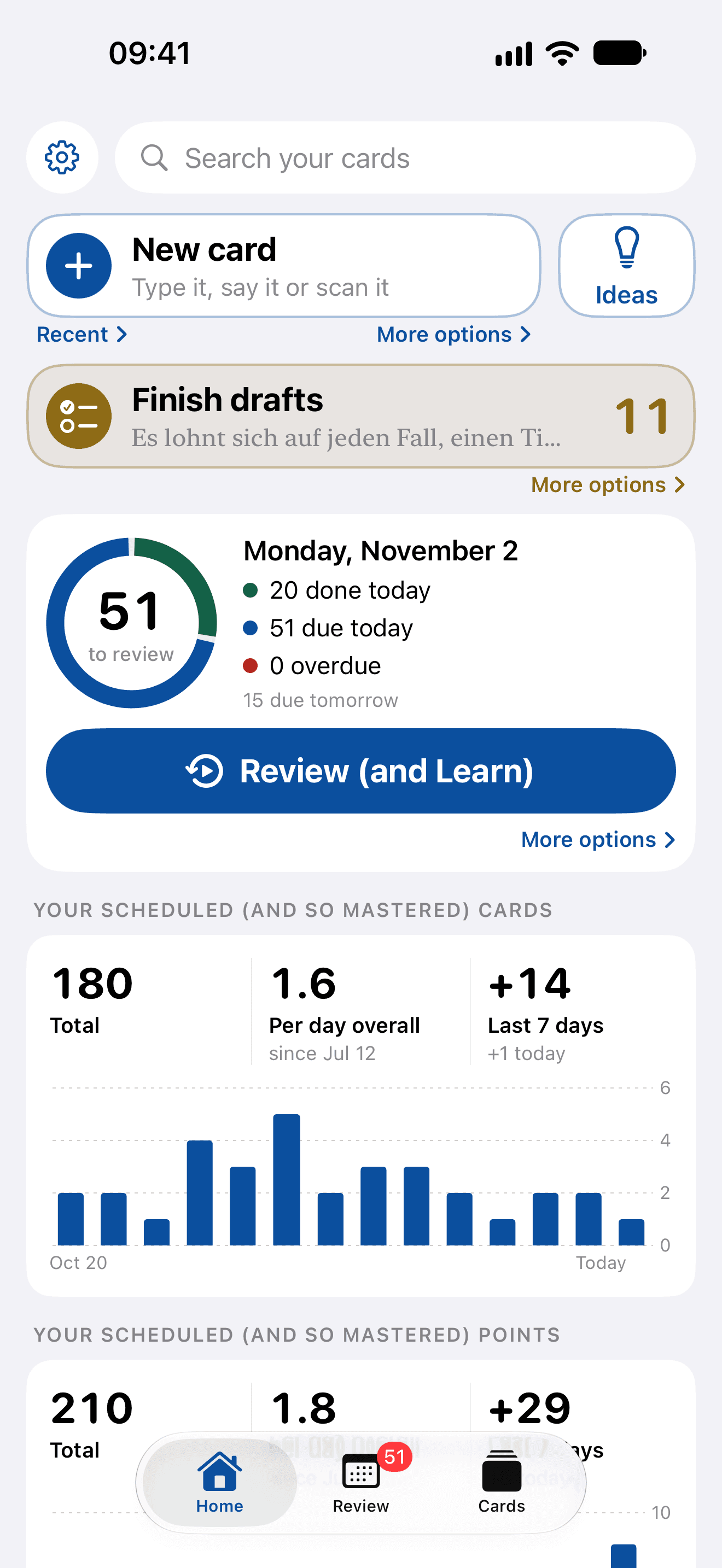
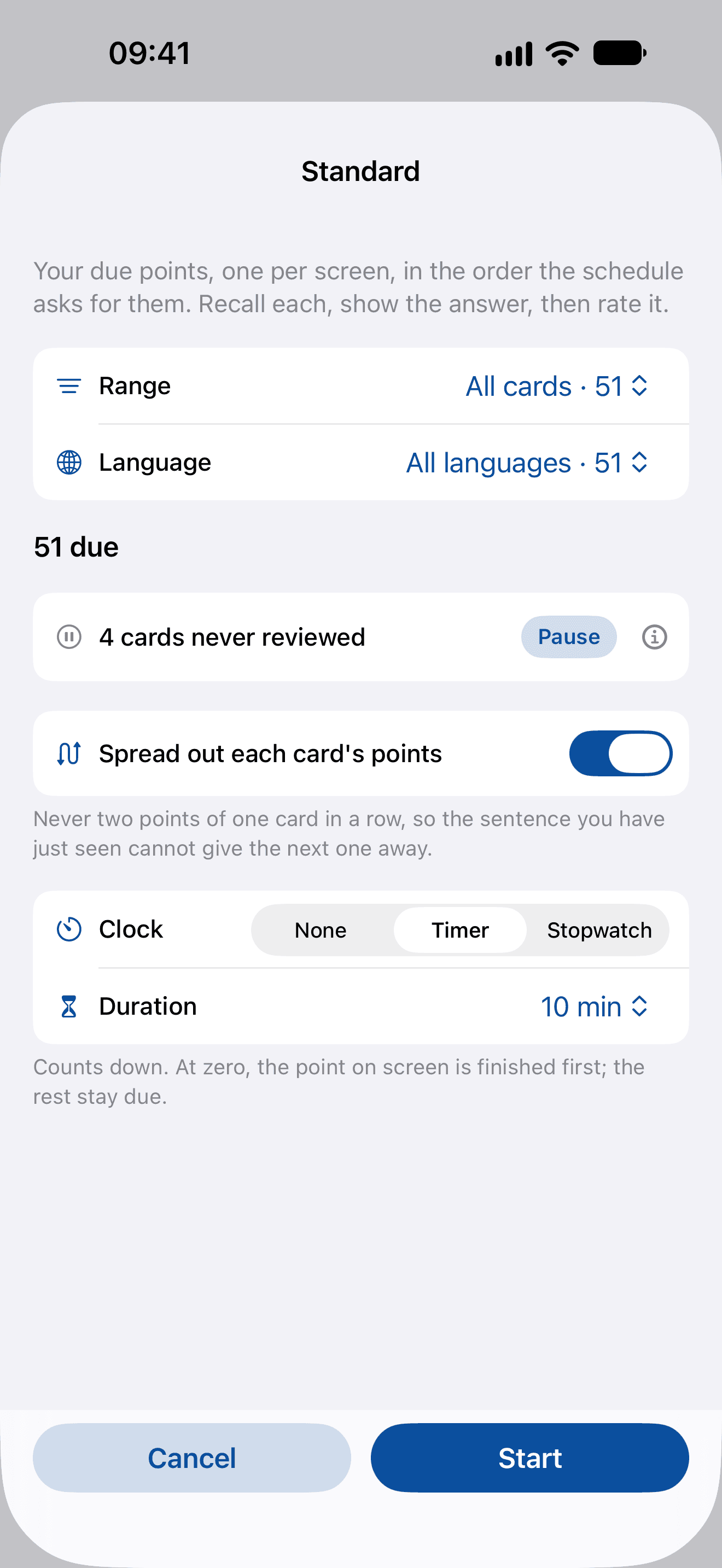
Every card you add is one more to recall tomorrow, next week and next month, and at the start they are all new. Add a few a day and give them the reviews that make them stay: Home counts how many enter your schedule each day. Added more than you can start? Standard’s sheet counts the cards you’ve never reviewed and pauses them in one tap; they wait as they are until you resume them.
Whatever the moment, it stays.